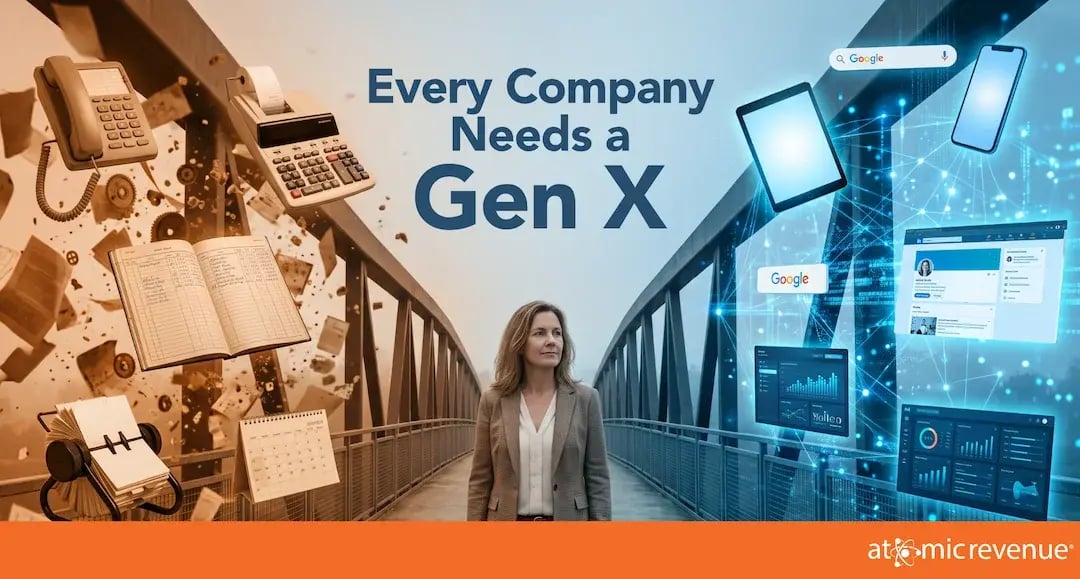
Somewhere in the middle of a "quick coffee chat" that ran long — the way good ones always do — Tara said the thing out loud: this is the classic "every company needs a Gen X."
We'd been swapping war stories for half an hour. Kendra started keeping her dad's books at 15, writing entries into the big green ledger books by hand and running double tape to make sure the numbers reconciled. When the family got an early PC, the whole revelation was: wait — the ledger is a spreadsheet now. You could type the numbers in and skip the tape. Tara, meanwhile, was the kid lying on the floor in front of a whiteboard at her parents' Amway meetings — not because she wanted to be, but because childcare wasn't in the budget. By seventh grade she was setting up the family's Tandy computer, doing the inventory, and reconciling a checkbook her parents didn't.
Neither of us thought we were "learning business." We were just doing the stuff in front of us. But that stuff turned out to be the education.
The generation that had to figure it out
Gen X — born roughly between 1965 and 1980 — gets called a lot of things. The "forgotten" generation. The "middle child" between the Boomers and the Millennials. The "latchkey kids" who came home to empty houses and let themselves in. What those labels miss is the part that actually matters in a business context: we came up in the gap between the analog world and the digital one, and we had to bridge it ourselves.
We moved the Rolodex into LinkedIn. We set up the dot-matrix printers and the CRM. We watched revenue operations get invented, then watched the term get borrowed and blurred into something else entirely. We learned the fundamentals on paper and then rebuilt them in software — twice, sometimes three times, as the tools changed underneath us.
That's not nostalgia. It's a specific, transferable skill: knowing why the thing works, not just which button makes it work. When the website breaks, when the CRM migration corrupts half the records, when the "AI-generated strategy" turns out to be a confident mess — you want someone in the room who has seen the underlying machinery, because they can fix the actual problem instead of the symptom.
"Anybody can do anything" — except you have to do the work
Here's the pattern we keep running into. Both of us have teenagers, and both of us have had the same conversation with them: the YouTube star you admire isn't just uploading videos. There's a team behind them analyzing which thumbnails convert, which descriptions pull people in, which formats hold attention. The polished, effortless version you see is the output of a lot of unglamorous work.
The wider culture has drifted toward "anybody can do anything, instantly." And sure — anybody can learn to do almost anything. But there's a step everyone wants to skip: you have to actually put in the reps. You don't get instantly good. It would be nice. It just doesn't work that way.
We see the business version of this constantly. Companies hand a critical function — the website, the marketing, the financial reporting — to someone with the title but none of the experience. That person reaches for AI to cover the gap, makes a giant mess, and now there's a bigger problem to clean up than there was to begin with. The instinct is right (build the skill in-house). The execution fails because nobody bridged the gap between "responsible for it" and "actually knows how to do it."
Why this is a business argument, not a memoir
This is where our two businesses come in, and why we clicked on that call.
Kendra does whole-business strategy for service providers — connecting the six pieces most owners look at in isolation: numbers, people, marketing, offers, systems, and the client journey. She builds the growth action plan and stays to help execute it. She doesn't hand over a binder and walk away, and she doesn't white-label anyone; her clients hold their own contracts with the specialists she recommends, because she's not there to sell a solution she gets a kickback on. She's there to help owners actually step into the CEO seat.
Tara runs Atomic Revenue on a three-part model: diagnose (a two-year Growth Operating Plan that gets a whole company aligned in about six weeks instead of six months of biased guessing), resolve (a subscription team of fractional specialists — CRM, web, copy, automation, AI — on one flat retainer, so a client gets what feels like an employee without juggling fifteen vendor contracts), and develop (pairing a client's own staff with experts to build the skill in-house, so the person responsible for the website actually learns to run it).
Different lanes, same conviction: strategy without execution is a binder on a shelf, and execution without experience is an expensive mess. Both of us built our businesses specifically to close that gap — and both of us learned to spot the gap because we lived it, from ledger books and Tandy computers all the way to the tech stack we run today.
The point
The world doesn't need Gen X to be nostalgic. It needs the thing Gen X had to build to survive: the ability to connect the old fundamentals to the new tools, to tell the difference between real work and the appearance of work, and to put in the reps instead of skipping to the highlight reel.
So the next time someone tells you anybody can do anything instantly — they're half right. Anybody can learn. But the value is still in the doing, and there's a whole generation that never got to skip that part.
Every company needs one of us in the room.
About the Authors
Tara Kinney is the founder of Atomic Revenue, a fractional revenue operations firm. Kendra Vyse is a whole-business strategist for service-based businesses. They met through the H7 network and have been trading war stories ever since.